
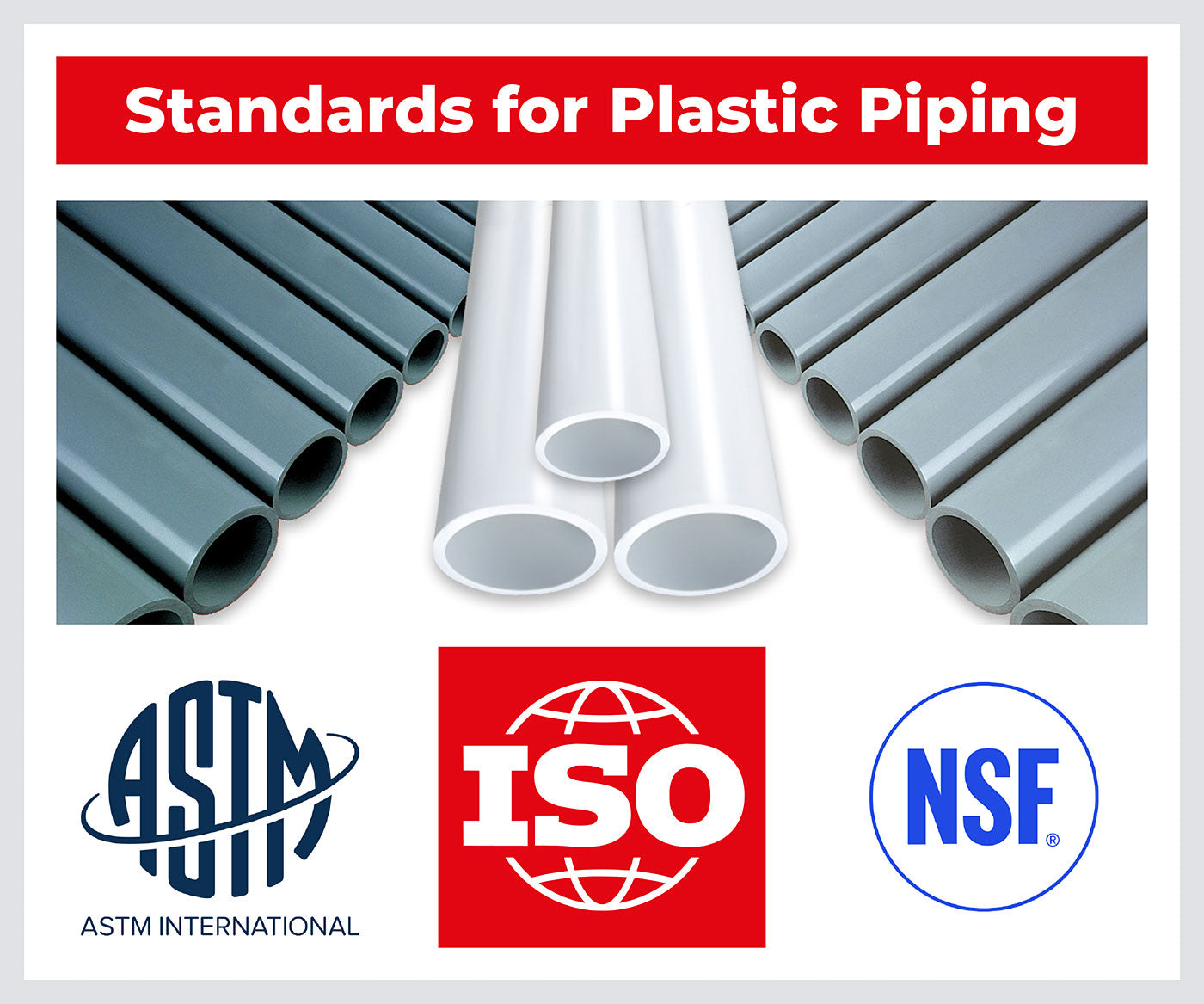
Standards define what great looks like in every piping system. They are how we guarantee proper and safe fabrication, assessment, installation, and utilization across industrial and commercial piping systems.
Let’s discuss the most important standards, ASTM, ISO, and NSF, that engineers and businesses rely on for safe, reliable, and quality services.
ASTM Standards
The American Society for Testing and Materials (ASTM) plastic pipes standards help ensure pipes, tubing, and fittings are safe, reliable, and suitable for industrial, commercial, and agricultural applications.These plastic pipe standards guide manufacturers, industrial facilities, plumbing professionals to ensure pipes are properly made, tested, installed, and used safely.
Key ASTM standards for plastic pipes include:
-
ASTM D1785: PVC Schedule 40 and 80 pipes for pressure applications
-
ASTM D2241: Pressure-rated PVC pipes
-
ASTM F441: CPVC pipes for hot- and cold-water systems
-
ASTM F1986-01: For Hot and Cold Drinking-Water Systems
Looking for more standards for plastic piping? Check out ASTM’s full page of Plastic Pipe Standards.
ISO Standards for Global Consistency
The International Organization for Standardization (ISO) develops standards that allow plastic piping products to be used confidently across global markets. international standards help guarantee that everyday products and services you use daily are safe, dependable, and of high quality. Some ISO standards for plastic piping include:
-
ISO 8283-4:1992: Dimensions of sockets and spigots for discharge systems inside buildings.
-
ISO 1452-2:2009: Plastics piping systems for water supply above-ground drainage, and sewer applications.
-
ISO/TS 18226:2006: Reinforced thermoplastic pipes for gas supply up to 4 MPa (40 bar)
-
ISO 7686:2005: Measuring opacity
NSF Standards
NSF has been a trusted source for health standards, testing, certification, consulting and training for food, water, health products and the environment.
-
NSF/ANSI 14: Confirms plastic pipes and fittings are strong and perform well under pressure.
-
NSF/ANSI 61: Limits chemicals and impurities that could leach into drinking water.
-
NSF/ANSI 372: Minimize lead contamination in drinking water.
Why Standards Matter
Plastic piping systems are only as strong as the standards behind them. Standards are the best way to design, produce, and manage these products and systems without errors, inefficiencies, or safety risks. By following standard guidelines from ASTM, ISO, and NSF, you ensure plastic piping systems are safe, efficient, and built to last.
For more information about plastic pipe standards, contact our team by filling out the contact form and a Sales & Support Team Member will follow up with you as soon as possible. If you need immediate assistance, we’re happy to take your call.