
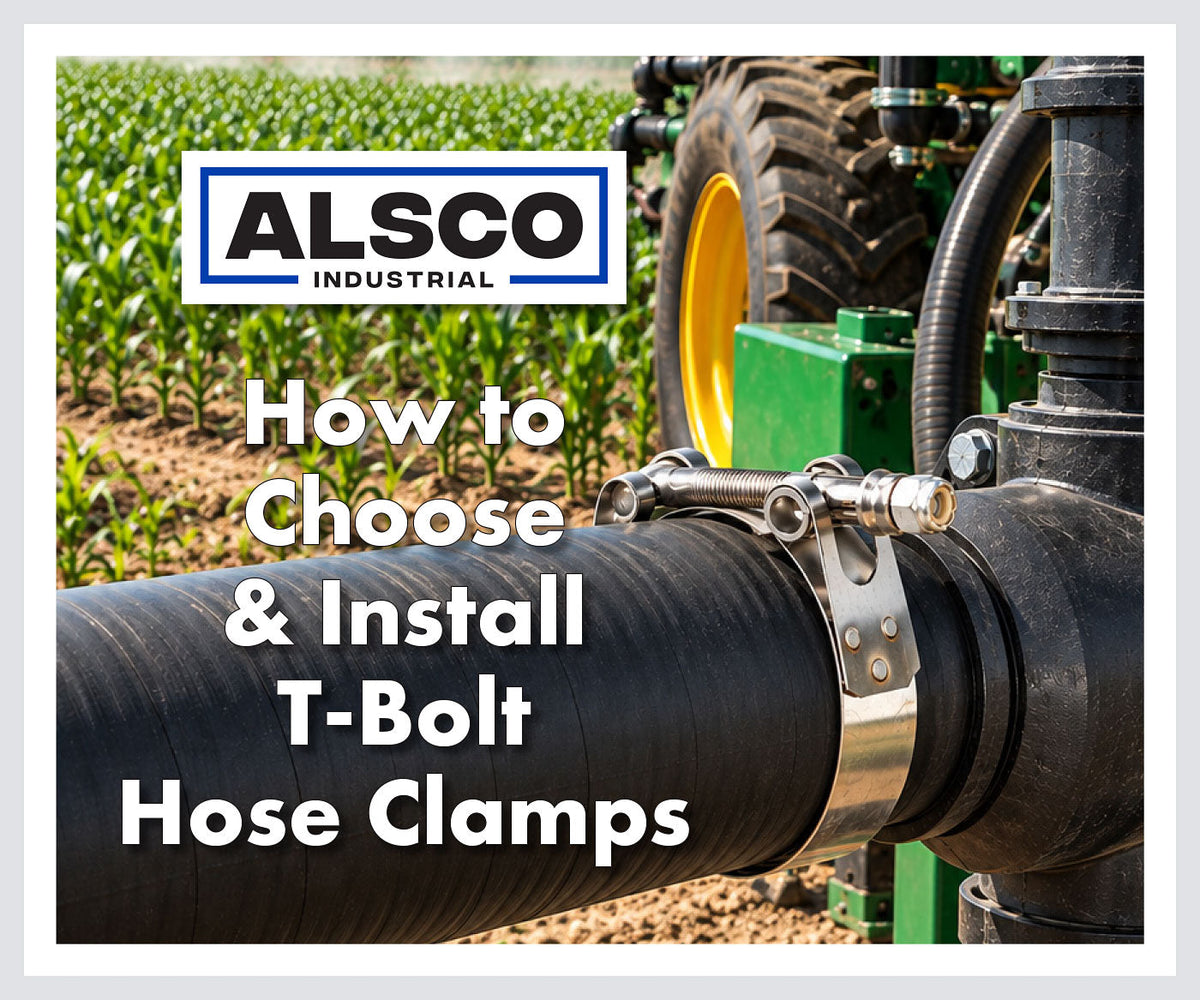
T-bolt hose clamps provide strong, uniform clamping force for securing hoses to fittings. They are commonly used in industrial fluid handling, agricultural equipment, pumping systems, and other applications requiring secure hose connections.
Choosing the correct clamp size and installing it properly helps prevent leaks and hose damage.
How to choose the correct T-bolt hose clamp size
T-bolt clamps are sized according to the outside diameter of the hose, not its inside diameter.
For the most accurate measurement, measure the hose outside diameter after it has been installed over the fitting. The hose may expand slightly when pushed onto a hose barb.
Select a clamp with an adjustment range that includes the measured outside diameter.
For example, if the installed hose measures 2” outside diameter, choose a clamp whose specified clamping range includes 2”.
Also consider the clamp’s band width, material, and suitability for the operating environment.
T-bolt hose clamp size chart
| Size | Clamping range | Part # |
|---|---|---|
| 1 in. | 1.20 in. to 1.34 in. | TC120 |
| 1-1/4 in. | 1.30 in. to 1.70 in. | TC130 |
| 1-1/4 in. | 1.62 in. to 1.87 in. | TC162 |
| 1-1/2 in. | 1.50 in. to 1.75 in. | TC150 |
| 1-1/2 in. | 1.81 in. to 2.06 in. | TC181 |
| 1-1/2 in. | 1.93 in. to 2.18 in. | TC193 |
| 2 in. | 2.06 in. to 2.40 in. | TC206 |
| 2 in. | 2.18 in. to 2.50 in. | TC218 |
| 2 in. | 2.24 in. to 2.55 in. | TC224 |
| 2 in. | 2.31 in. to 2.62 in. | TC231 |
| 2 in. | 2.50 in. to 2.81 in. | TC250 |
| 2 in. | 2.87 in. to 3.18 in. | TC287 |
| 3 in. | 3.12 in. to 3.49 in. | TC312 |
| 3 in. | 3.31 in. to 3.62 in. | TC331 |
| 3 in. | 3.43 in. to 3.75 in. | TC343 |
| 4 in. | 4.25 in. to 4.56 in. | TC425 |
| 4 in. | 4.38 in. to 4.76 in. | TC438 |
| 4 in. | 4.56 in. to 4.94 in. | TC456 |
Joining Banjo manifold flange connections? Use manifold T-bolt flange clamps, which are sized by flange size rather than hose outside diameter.
Shop all clamps.
How to install a T-bolt hose clamp
- Prepare the connection. Inspect the hose and fitting for damage. Slide the clamp over the hose before installing the hose onto the fitting.
- Install the hose. Push the hose fully onto the fitting, making sure it is properly seated.
- Position the clamp. Place the clamp over the appropriate sealing area of the hose connection. Keep the band straight and avoid positioning it too close to the hose end.
- Tighten the clamp. Use a wrench or socket to tighten the nut gradually. Follow the specified installation torque when provided. For our stainless steel T-bolt hose clamps, the working torque is 50 to 80 in-lb, with a maximum of 125 in-lb. Avoid overtightening, which can damage the hose.
- Check the connection. Confirm that the clamp is secure and correctly positioned. Perform an approved leak test before placing the system into service.
Common mistakes to avoid
- Selecting a clamp based only on hose inside diameter
- Using a clamp outside its specified adjustment range
- Positioning the clamp incorrectly
- Overtightening or undertightening
- Using a damaged clamp or hose
Final considerations
Proper T-bolt clamp installation starts with measuring the installed hose outside diameter, selecting the correct clamp range, and tightening the clamp to the appropriate specification.
Periodically inspect connections for loosening, corrosion, or signs of leakage, particularly in systems exposed to vibration or temperature changes.