
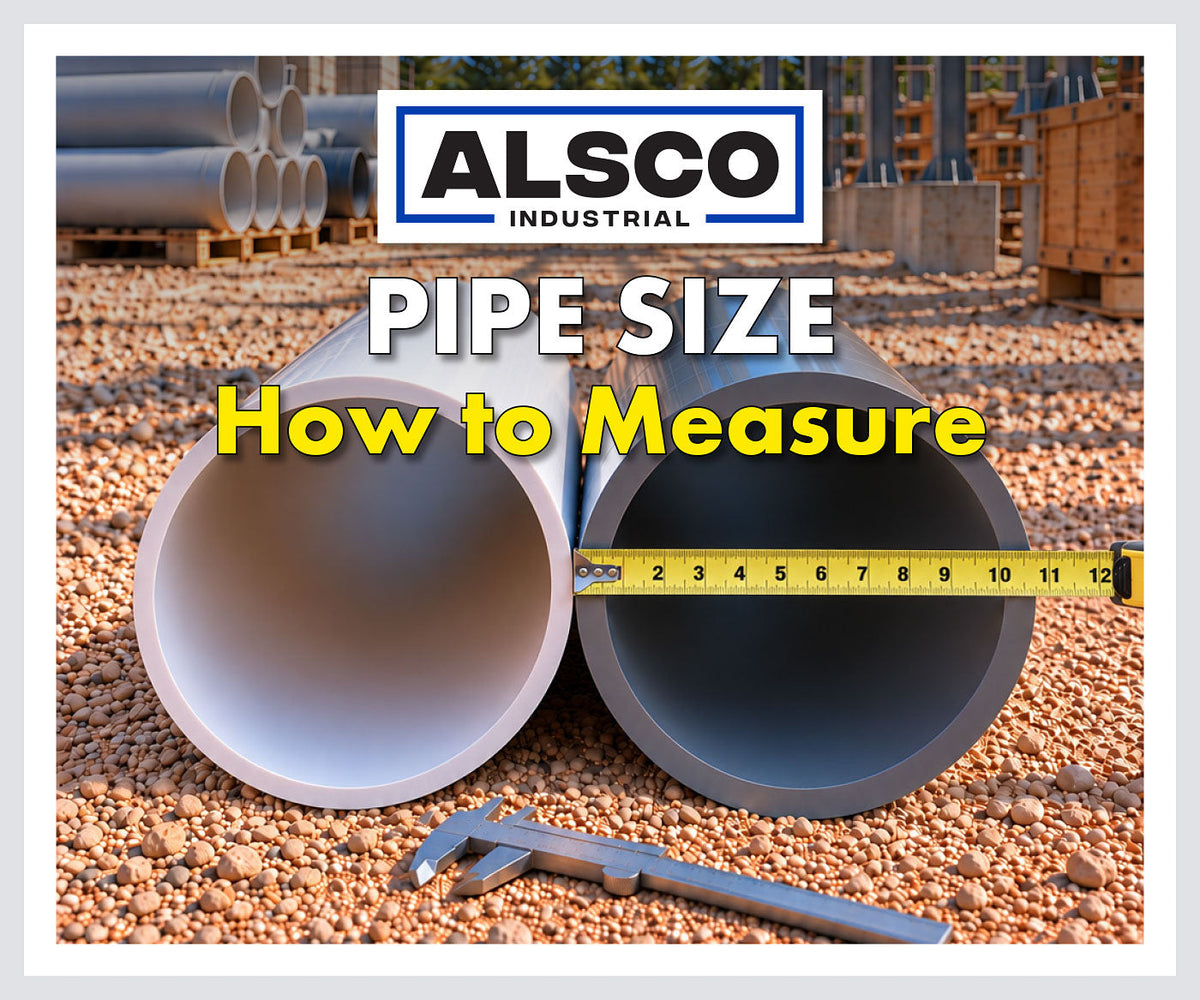
Plastic and metal pipe is sold by nominal size, a trade name that does not match any measurement on the pipe. A 1 in. pipe is not 1 in. across on the outside or the inside. Measuring the outside diameter and matching it to a size chart is the most reliable way to know what size you have before you order pipe, fittings or valves.
Why Pipe Size Does Not Match the Measurement
Pipe is sized by nominal pipe size (NPS). For each nominal size, the outside diameter (OD) is fixed. The schedule, such as Schedule 40 or Schedule 80, sets the wall thickness. A thicker wall makes the inside diameter (ID) smaller, but the OD stays the same.
For example, every 2 in. pipe has an OD of 2.375 in. A 2 in. Schedule 40 PVC pipe has an average ID of 2.049 in., and a 2 in. Schedule 80 PVC pipe has an average ID of 1.913 in. Because the OD is the same, fittings are sized to the nominal size, not to either measurement.
How to Measure Pipe Size
- Check the print line first. PVC pressure pipe is marked along its length with the nominal size, material, schedule and pressure rating. If the print is readable, you may not need to measure.
- Measure the outside diameter. Use calipers across the outside of the pipe for the most accurate reading. A tape measure or ruler held across the end of the pipe also works on larger sizes.
- No access to the end of the pipe? Wrap a string or flexible tape around the pipe, measure the circumference, and divide by 3.14 to get the OD.
- Match the OD to the chart below to find the nominal size.
- Identify the schedule if it matters. Read the print line, or measure the inside diameter at the cut end and compare it to the Schedule 40 and Schedule 80 columns.
Pipe Size Chart: Nominal Size, OD and ID
Dimensions in inches for PVC pipe. Inside diameters are averages and can vary slightly by manufacturer.
| Size | OD | Sch 40 ID | Sch 80 ID |
|---|---|---|---|
| 1/8 | 0.405 | 0.261 | 0.203 |
| 1/4 | 0.540 | 0.354 | 0.288 |
| 3/8 | 0.675 | 0.483 | 0.407 |
| 1/2 | 0.840 | 0.608 | 0.528 |
| 3/4 | 1.050 | 0.810 | 0.724 |
| 1 | 1.315 | 1.033 | 0.935 |
| 1-1/4 | 1.660 | 1.364 | 1.256 |
| 1-1/2 | 1.900 | 1.592 | 1.476 |
| 2 | 2.375 | 2.049 | 1.913 |
| 2-1/2 | 2.875 | 2.445 | 2.289 |
| 3 | 3.500 | 3.042 | 2.864 |
| 4 | 4.500 | 3.998 | 3.786 |
| 6 | 6.625 | 6.031 | 5.709 |
| 8 | 8.625 | 7.943 | 7.565 |
| 10 | 10.750 | 9.976 | 9.492 |
| 12 | 12.750 | 11.890 | 11.294 |
For wall thickness, pressure ratings, temperature de-rating and support spacing, see PVC and CPVC Pipe Technical Data.
How to Measure Fittings
Fittings are named by the nominal size of the pipe they connect to, not by their own measurements.
- Socket (slip) fittings: the socket slides over the outside of the pipe, so the inside of the socket measures just over the pipe OD. A 1 in. socket, for example, measures about 1.325 in. across at the entrance. Measure across the inside of the socket and match it to the OD column in the chart.
- Threaded fittings: NPT thread sizes use the same nominal sizes as pipe. A male 1 in. NPT thread measures 1.315 in. across the outside of the threads, the same as 1 in. pipe.
A 1 in. socket fitting and a 1 in. threaded fitting both connect to 1 in. pipe. Check whether you need socket or threaded ends before ordering.
Pipe vs. Tubing and Hose
Tubing and hose are not sized by nominal pipe size. Push-fit tubing is sized by its actual outside diameter. Flexible PVC tubing and hose are listed by inside diameter, usually with the outside diameter as well. A 1/2 in. tube, 1/2 in. hose and 1/2 in. pipe are three different sizes, so confirm which one you have before ordering a fitting.
Common Sizing Mistakes
- Ordering by the measured OD instead of the nominal size, such as ordering 1-1/4 in. for pipe that measures about 1.3 in. across (that is 1 in. pipe)
- Measuring the inside diameter, which changes with the schedule
- Mixing up socket and threaded ends
- Confusing pipe, tubing and hose sizes
- Assuming Schedule 40 and Schedule 80 pipe of the same size have different ODs
Shop Pipe, Fittings and Valves
Browse our pipe, fittings and valves, or contact us if you are not sure what size you need.
Frequently Asked Questions About Pipe Size
Q: Is pipe size measured on the inside or outside?
A: Neither matches the nominal size. Measure the outside diameter, because it stays the same for every schedule, and match it to a size chart.
Q: How can I tell if a pipe is 3/4 in. or 1 in.?
A: Measure the outside diameter. 3/4 in. pipe measures 1.050 in. across, and 1 in. pipe measures 1.315 in.
Q: What is the actual size of a 4 in. pipe?
A: 4 in. pipe has an outside diameter of 4.500 in. The inside diameter depends on the schedule: an average of 3.998 in. for Schedule 40 PVC and 3.786 in. for Schedule 80 PVC.
Q: Do Schedule 40 and Schedule 80 pipe use the same fittings?
A: Both have the same outside diameter for a given nominal size, and socket dimensions are the same for both, so either pipe fits the same size socket. A system's pressure rating is limited by its lowest-rated component, so match the fitting rating to the application.