
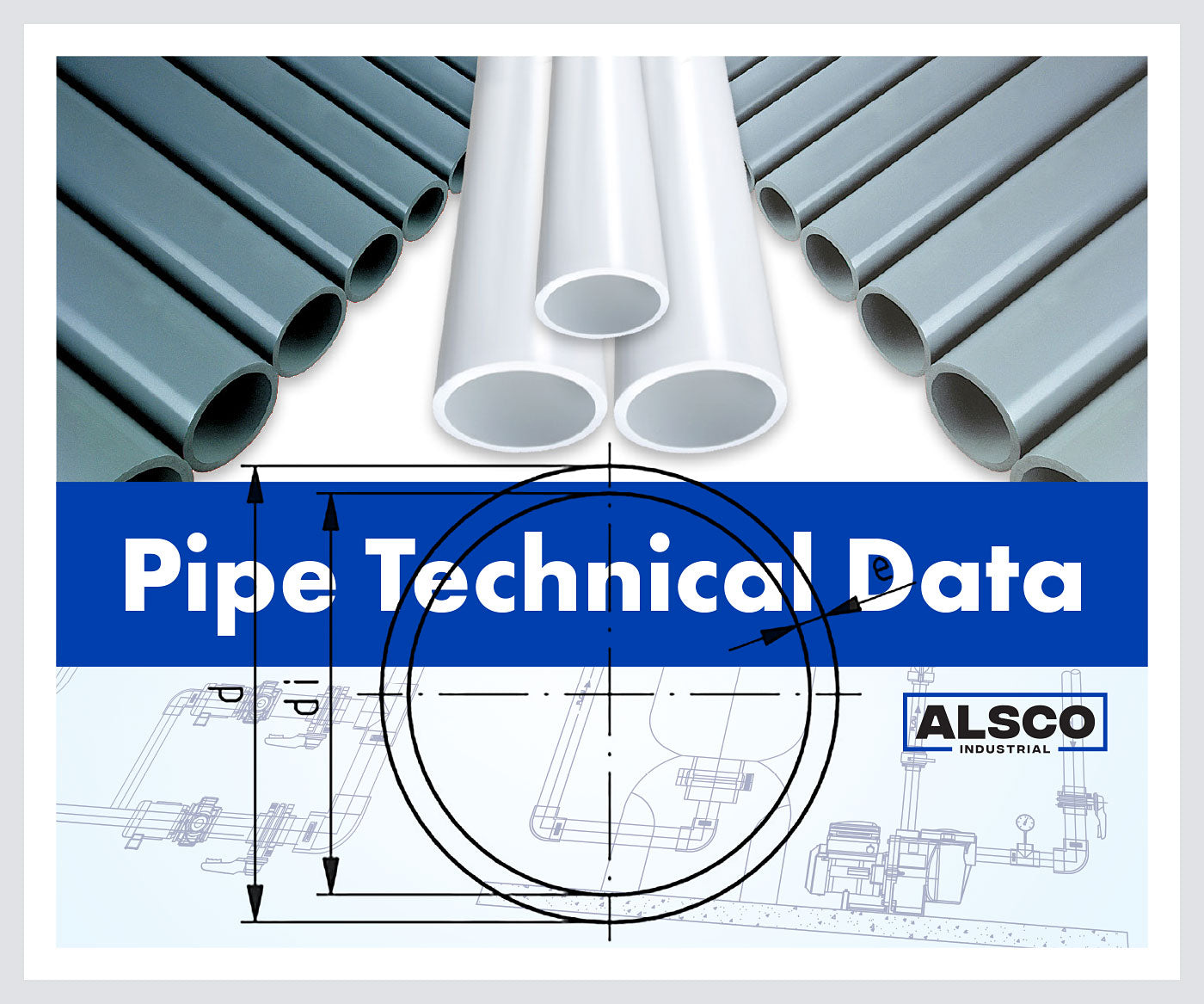
Selecting the right thermoplastic pipe for a fluid handling system involves more than choosing a size. Wall thickness, pressure rating, operating temperature, and support spacing all play a role in long-term system performance. This guide covers the essential technical data for Schedule 40 and Schedule 80 PVC and CPVC pipe so you can specify with confidence.
Schedule 40 vs. Schedule 80: What Is the Difference?
Schedule 40 and Schedule 80 pipe share the same outside diameter for any given nominal size. The difference is wall thickness. Schedule 80 has a thicker wall, which gives it a smaller inside diameter and significantly higher pressure ratings compared to Schedule 40 of the same size.
For example, a 2" Schedule 40 PVC pipe has an inside diameter of 2.049" and a maximum working pressure of 280 PSI at 73°F. The same nominal size in Schedule 80 has an inside diameter of 1.913" and a maximum working pressure of 400 PSI. That additional wall thickness makes Schedule 80 the preferred choice for higher-pressure applications, chemical processing environments, and systems where threaded connections are required. Schedule 40 is not recommended for threading.
Both schedules are available in PVC and CPVC, and both carry NSF certification for potable water applications where required.
Pressure Ratings and Temperature De-Rating
The maximum working pressure values published for PVC and CPVC pipe apply at 73°F with water and solvent-cemented joints. As operating temperature rises, those pressure ratings must be reduced. This is one of the most important and most overlooked factors in thermoplastic pipe system design.
PVC pipe de-rates aggressively with heat. At 100°F the working pressure is 62 percent of the rated value. At 120°F it drops to 40 percent. Above 140°F, PVC is not recommended for pressure service. CPVC handles elevated temperatures significantly better. At 120°F it retains 65 percent of its rated pressure capacity. At 140°F that figure is 50 percent, and at 160°F it drops to 40 percent. CPVC remains serviceable up to 200°F with appropriate de-rating applied.
For systems handling fluids other than water, chemical resistance must also be verified. Temperature and chemical exposure work together to affect long-term performance, and the two factors should always be evaluated together when selecting pipe material.
Material Properties: PVC vs. CPVC
PVC and CPVC share many of the same strengths and both meet ASTM standards governing compound quality, physical properties, and fitting dimensions. The key difference between them is temperature performance.
PVC is the workhorse of the industry. It offers strong tensile strength, broad chemical compatibility, and reliable performance up to a maximum continuous service temperature of 140°F, making it the right choice for the majority of ambient-temperature fluid handling applications.
CPVC is chemically similar to PVC but formulated to handle higher temperatures, remaining serviceable up to 200°F with appropriate de-rating applied. It is the preferred material for hot water systems, chemical processing lines, and any application where temperatures regularly push beyond what PVC can reliably handle.
Both materials carry an Underwriters Laboratories rating of 94V-O. For applications requiring even greater chemical or temperature resistance, Alsco Industrial also carries PVDF and polypropylene piping systems.
Pipe Support Spacing
Thermoplastic pipe requires more frequent support than metal pipe, and support spacing decreases as operating temperature increases. A 2" Schedule 40 PVC pipe at 60°F can span 6 feet between supports. At 100°F that spacing drops to 5 feet, and at 140°F it reduces further to 3 feet. Schedule 80 provides slightly longer allowable spans at equivalent temperatures due to its heavier wall.
CPVC follows a similar pattern. Support spacing is based on continuous spans carrying fluids with a specific gravity up to 1.00 and does not account for concentrated loads or the weight of aggressive reagents. Supports should allow for axial movement of the pipe and should not be clamped tightly.
For systems operating consistently above 120°F, CPVC or continuous support should be considered rather than relying on standard span tables for PVC.
Specifying the Right Pipe for Your Application
A few straightforward rules cover the majority of thermoplastic pipe applications. Use Schedule 40 PVC for standard pressure and ambient temperature service. Step up to Schedule 80 when pressure requirements are higher, when threaded connections are needed, or when additional wall strength adds value. Specify CPVC when operating temperatures exceed 140°F or when the chemical environment demands it. Verify temperature de-rating factors any time the system operates above 73°F, and confirm support spacing requirements before finalizing system layout.
Alsco Industrial has been supplying thermoplastic fluid handling products since 1983 and carries Schedule 40 and Schedule 80 pipe in PVC and CPVC from 1/8" through 16", along with the fittings, valves, and adhesives needed for complete system installation. Contact our team at 888-941-3030 or sales@alscoind.com to discuss your application.
Download the Pipe Technical Data Reference
The PVC and CPVC pipe technical data including dimensions, pressure ratings, temperature de-rating factors, support spacing tables, and material properties is available as a downloadable PDF.