
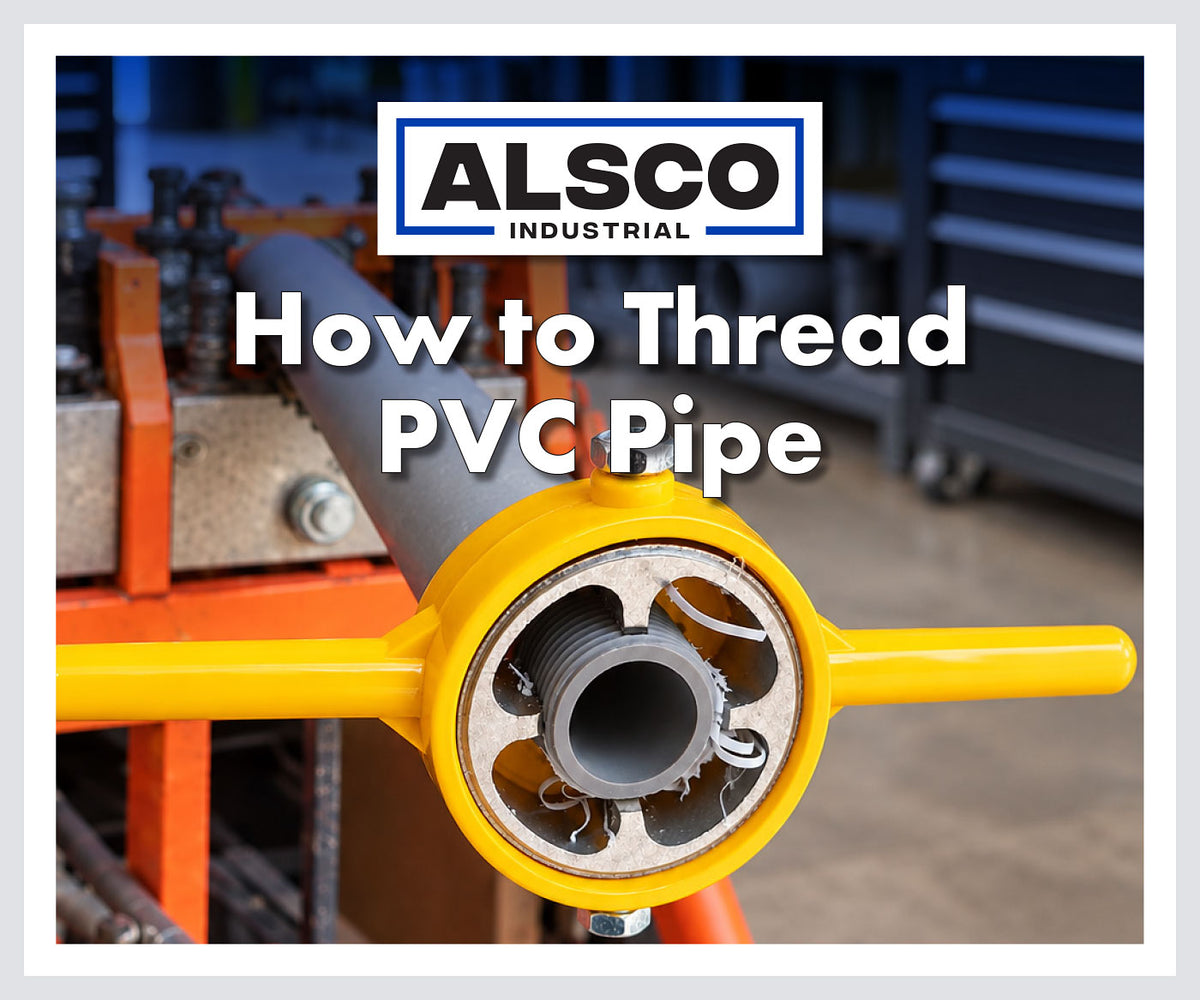
Threaded connections let you take a plastic piping system apart easily and connect plastic to metal valves, pumps and equipment. PVC and CPVC pipe can be threaded, but only if the wall is thick enough, and threading cuts the pipe's pressure rating in half. This guide covers when you can thread plastic pipe, how to do it, and when a threaded fitting is the better choice.
Can You Thread PVC Pipe?
- Thread only Schedule 80 or heavier pipe. Threading Schedule 40 pipe is not a recommended practice because the wall is not thick enough.
- Threading reduces the pressure rating by 50%. Cutting threads removes pipe wall, so threaded pipe is rated at half the pressure of the same pipe with plain ends at 73°F.
- Metric pipe cannot be threaded with standard pipe threads, because its outside diameter is not the same as iron pipe size (IPS) pipe.
When to Use Threaded Connections
Threaded plastic connections are useful for systems that need to be taken apart, temporary installations, and transitions from plastic to metal.
Threaded connections are not recommended for:
- High pressure systems
- Pipe sizes larger than 4 in.
- Lines where a leak would be dangerous or costly
- Temperatures above 110°F for PVC or 150°F for CPVC. Use flanges or unions instead where the line must come apart at higher temperatures.
Consider Threaded Fittings Instead
In many cases you can avoid cutting threads altogether. Molded male and female adapters, threaded Schedule 80 fittings and factory-threaded nipples give you a threaded connection without threading the pipe in the field. A male adapter solvent-cemented onto plain-end pipe, for example, connects to a female threaded valve or fitting without cutting into the pipe wall.
Tools You Need
- A pipe cutter or plastic pipe saw (see How to Cut PVC Pipe)
- A deburring tool
- A die stock with a guide, and pipe dies that are clean, sharp and made for plastic pipe
- A pipe vise, plus a wooden plug for the pipe end
- A strap wrench
- PTFE tape or a thread sealant rated for plastic pipe
How to Thread PVC Pipe
- Cut the pipe square and remove all burrs and sharp edges from the end.
- Secure the pipe in a vise without scratching or deforming it. Inserting a wooden plug in the pipe end helps keep the pipe from being crushed.
- Start the die square to the pipe. Use a die stock with a guide so the threads start and run square to the pipe axis.
- Cut the threads to the standard length for the pipe size. If you use cutting oil, keep it to a minimum.
- Clean the threads and check them for damage.
- Seal the threads with PTFE tape or a thread sealant rated for plastic, but not both. See How to Seal PVC, CPVC and PP Threads.
- Assemble by hand to avoid cross threading, then finish with a strap wrench as specified by the fitting manufacturer. Do not overtighten.
Pipe Thread Sizes
Plastic pipe uses American standard taper pipe threads (NPT). The number of threads per inch changes with pipe size.
| Size | Pipe OD (in.) | Threads per inch |
|---|---|---|
| 1/2 | 0.840 | 14 |
| 3/4 | 1.050 | 14 |
| 1 | 1.315 | 11.5 |
| 1-1/4 | 1.660 | 11.5 |
| 1-1/2 | 1.900 | 11.5 |
| 2 | 2.375 | 11.5 |
| 2-1/2 | 2.875 | 8 |
| 3 | 3.500 | 8 |
| 4 | 4.500 | 8 |
Not sure what size pipe you have? See How to Measure Pipe Size.
Connecting Plastic to Metal
- Plastic male into metal female: acceptable if no heat is involved and both lines are anchored right next to the joint.
- Metal male into plastic female: avoid it. Metal does not compress the way plastic does, and the female plastic thread can split. Where this connection cannot be avoided, use a fitting designed for it, such as Schedule 80 Special Reinforced (SR) fittings, which have a reinforcing collar on the female thread.
Fixing a Leaking Threaded Joint
If a plastic-to-plastic joint, or a plastic male thread in a metal female thread, leaks during pressure testing, tighten it up to an additional 1/2 turn. Threaded joints can also fracture or leak when the pipe is misaligned, so support the pipe and install it without bending.
Shop Pipe, Fittings and Sealants
- PVC Schedule 80 pipe
- Clear PVC Schedule 80 pipe
- CPVC Schedule 80 pipe
- PVC Schedule 80 threaded nipples
- Clear PVC Schedule 80 threaded nipples
- CPVC Schedule 80 threaded nipples
- PVC Schedule 80 fittings
- PVC Schedule 80 Special Reinforced fittings
- CPVC Schedule 80 fittings
- Thread sealants and PTFE tape
Not sure whether to thread or use a threaded fitting? Contact us.
Frequently Asked Questions About Threading PVC Pipe
Q: Can you thread Schedule 40 PVC pipe?
A: It is not recommended. Schedule 40 does not have enough wall thickness. Thread only Schedule 80 or heavier pipe.
Q: Does threading PVC pipe reduce its pressure rating?
A: Yes. Threaded pipe is rated at 50% of the pressure rating of the same pipe with plain ends at 73°F.
Q: Should I use Teflon tape or pipe dope on PVC threads?
A: Either one, as long as the sealant is rated for plastic pipe, but never both on the same joint.
Q: What kind of threads does PVC pipe use?
A: American standard taper pipe threads (NPT), the same thread standard used on metal pipe of the same nominal size.