
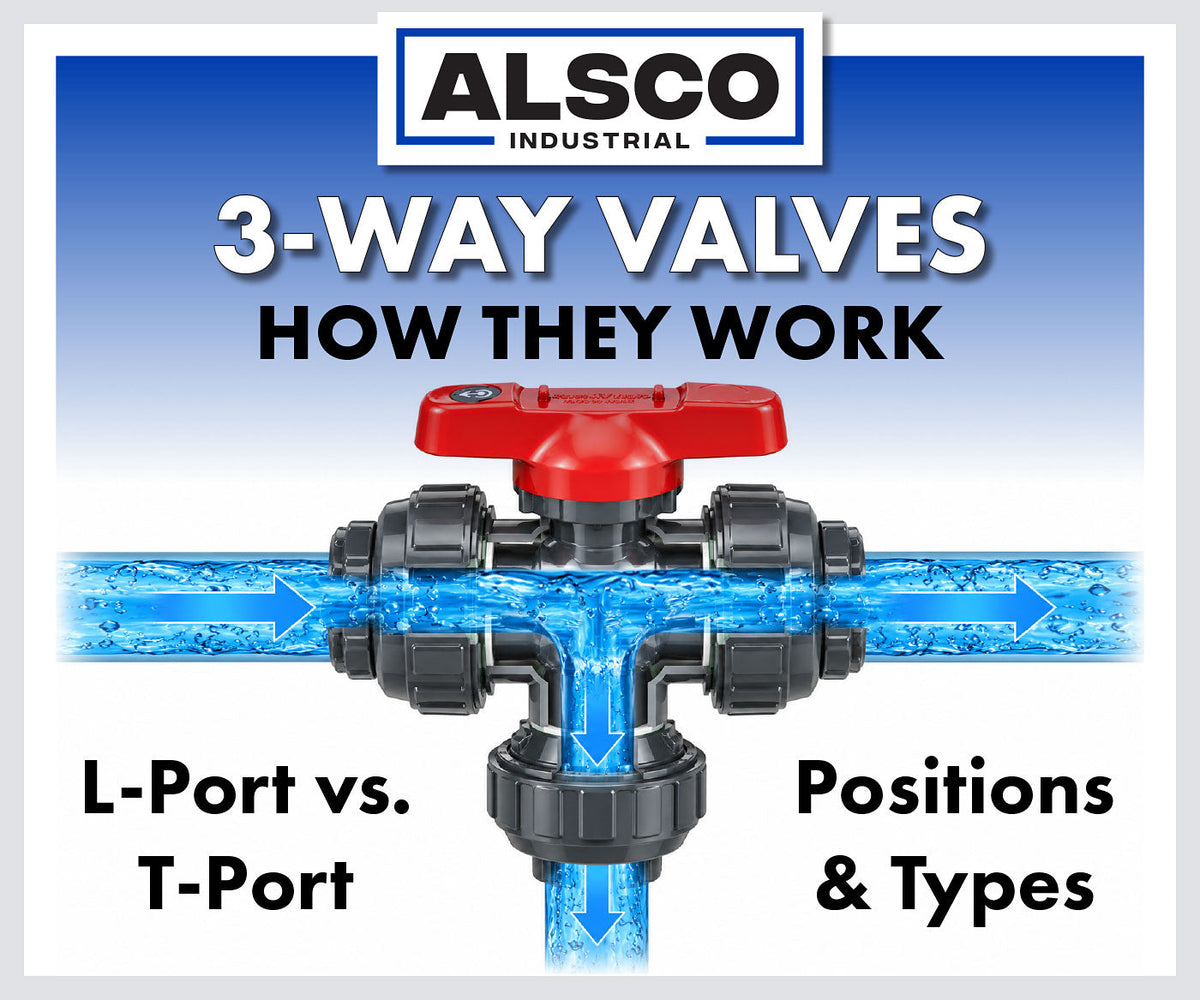
A 3-way valve has three ports, where a standard valve has two. Along with turning flow on and off, it can send flow from one line to either of two others, combine two lines into one, or in some designs shut off flow completely. This guide explains how a 3-way ball valve works, the difference between L-port and T-port, and how to choose the right one.
2-Way vs. 3-Way Valves
A 2-way valve has one inlet and one outlet and turns flow on or off along a single path. A 3-way valve adds a third port so it can direct, select or mix flow between lines. If you only need to start and stop flow, a 2-way valve is simpler. If you need to send flow to more than one place, a 3-way valve does the job of several components.
How Does a 3-Way Valve Work?
A 3-way ball valve has a body with three ports and a ball with a drilled passage, called the bore. Turning the handle rotates the ball, and the shape of the bore decides which ports are connected. Two of the ports sit across from each other, like the ends of a tee. These are the side ports. The third port, in the middle, is the center port.
3-way valves are used to:
- Divert flow from one inlet to either of two outlets, such as switching between two tanks or two pumps
- Select between two inlets feeding one outlet
- Mix two streams, on valves designed for a mixing position
One 3-way valve can replace a tee and two separate valves, which saves space and connections.
L-Port vs. T-Port
L-port. The bore is shaped like an L and connects the center port to one side port at a time. Turning the handle moves flow from one side port to the other. Depending on the valve, an L-port can also be set to a shut-off position where no ports are connected. An L-port cannot connect the two side ports to each other.
T-port. The bore is shaped like a T. Depending on the handle position, it can connect all three ports at once, connect the two side ports straight through, or connect the center port to either side. Because a T-port always leaves a flow path open, it is not used where full shut-off is needed.
Port options, handle positions and stops vary by valve. Always check the flow diagram for the valve you are using before installing it.
2-Position vs. 3-Position Valves
2-position (diverter). A quarter turn (90 degrees) switches flow from one side port to the other. There is no off position, and the in-between positions can be used to blend the two streams.
3-position (multiport). The handle turns 180 degrees, with flow to one side port at 0 degrees, shut-off at 90 degrees, and flow to the other side port at 180 degrees. In the in-between positions, the two side streams are kept from mixing.
Some valves need a separate stop ring or turn limiter to hold the handle at a mixing or mid position. Actuated 3-way valves can also be ordered with a center-off option that adds the 90 degree off position.
Horizontal vs. Vertical 3-Way Valves
3-way ball valves come in horizontal and vertical body styles. On a horizontal valve, all three ports sit in the same plane. On a vertical valve, the third port points down from the bottom of the body. Choose the style that matches your piping layout, and check that the port option you need is offered in that style.
How to Tell Which Way a 3-Way Valve Is Set
The handle on a 3-way valve does not always show the flow path the way it does on a standard ball valve. Many 3-way valves have a position indicator on the stem or handle that shows which ports are connected. Check the indicator and the valve's flow diagram rather than relying on the handle direction alone.
Choosing a 3-Way Valve
- Decide what the valve needs to do: divert, select, mix, or also shut off.
- Choose the port style: L-port when you need flow to one side at a time or a shut-off position, T-port when you need flow through all three ports or straight through.
- Choose 2-position or 3-position based on whether you need an off position.
- Match the body and seal materials to the fluid, temperature and pressure. Contact us for help.
- Choose the end connections (socket, threaded or flanged) and confirm the size. See How to Measure Pipe Size if you are not sure.
- Decide on manual or actuated operation.
Some 3-way valves are not rated for compressed air or gas, so confirm the rating before using one in air or gas service.
Shop 3-Way Valves
Browse our 3-way and multiport ball valves, or see How to Choose the Right Industrial Valve to compare other valve types.
Frequently Asked Questions About 3-Way Valves
Q: Can you shut off a 3-way valve?
A: It depends on the design. A 3-position L-port valve has an off position at 90 degrees. A 2-position diverter and a T-port valve always leave a flow path open, so they cannot fully shut off flow.
Q: What is the difference between an L-port and a T-port 3-way valve?
A: An L-port connects the center port to one side port at a time. A T-port can connect all three ports at once or connect the two side ports straight through.
Q: Can a 3-way valve be used for mixing?
A: Yes, if it is designed for it. Diverter valves can blend two streams in the in-between positions, and some valves offer a mixing port option with a stop ring to hold the mid position.
Q: Is a 3-way valve the same as a diverter valve?
A: A diverter is one type of 3-way valve. It switches flow between two outlets with a quarter turn and has no off position.