
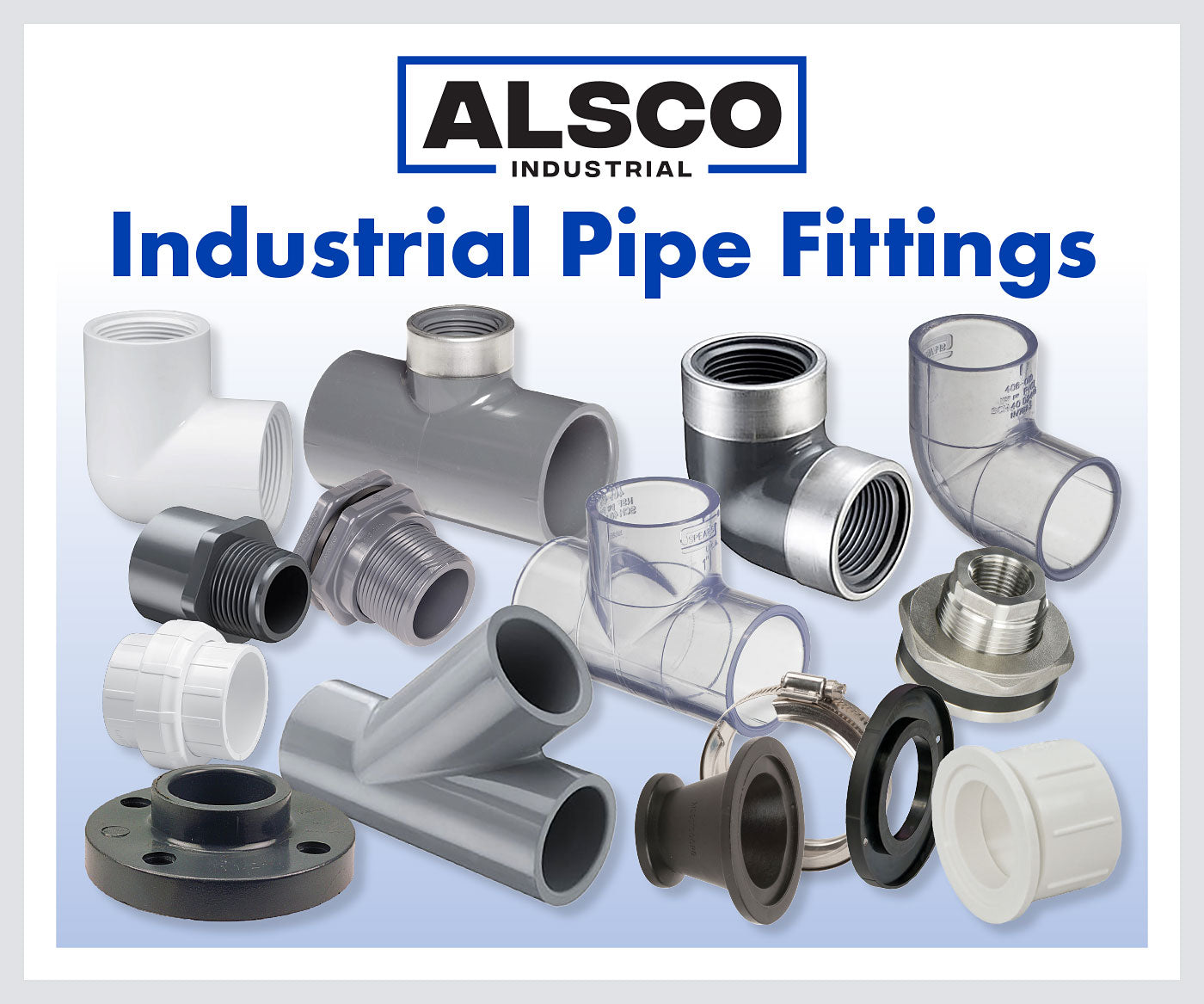
Pipe fittings are the components that connect, redirect, branch, and terminate piping in a fluid handling system, and choosing the right one for each connection point is what keeps a system leak free and serviceable for years. With so many shapes, connection styles, and materials available, it's easy to default to whatever was used last time. Understanding what each fitting actually does, though, makes it much easier to build a system that's easier to maintain and less prone to failure down the line.
What a Fitting Actually Does
Every fitting in a piping system exists to solve one of a few basic problems: changing direction, joining two pipe runs, branching flow off to a new line, adapting between sizes or materials, or allowing a section of pipe to be removed for service. Once you think about fittings in terms of the job they're doing rather than just their shape, picking the right one for a given spot in the system becomes a lot more straightforward.
Elbows: Changing Direction
Elbows redirect flow, most commonly at 90 degrees or 45 degrees, and they're one of the most frequently used fittings in any piping layout. A 90 degree elbow makes a sharp turn, useful when space is tight, while a 45 degree elbow changes direction more gradually and creates less turbulence and friction loss in the line. Street elbows, which have one end sized to insert directly into another fitting without a separate piece of pipe between them, are useful for tight configurations where every inch of clearance matters.
Tees: Branching the Line
A tee lets one line split into two, or lets a branch line tie into a main run. Tees come in equal sizes on all three openings, or as reducing tees where the branch is a smaller diameter than the main line. Because a tee introduces a change in flow direction and volume at that junction, it's worth paying attention to orientation, particularly on gravity fed or low pressure systems where flow needs to be preserved down both paths.
Couplings and Adapters: Joining and Transitioning
Couplings join two lengths of pipe of the same size and material in a straight run, which comes up constantly during repairs or when extending an existing line. Adapters do a similar job but across a transition, moving from one connection type to another, such as from solvent weld socket to male or female threaded pipe, or from one pipe material to another. Reducing bushings and reducing couplings handle the size change when a line needs to step down or up in diameter, which is common where a main trunk line feeds smaller branch lines.
Unions: Building in Serviceability
A union is a three-part fitting that lets a section of pipe or a piece of equipment be disconnected without cutting the line or unthreading a long run of pipe. Anywhere a valve, pump, or piece of equipment might need to come out for service or replacement, a union just upstream and downstream of it saves significant time over the life of the system. True union ball valves take this a step further by building the union directly into the valve body, so the valve itself can be removed without disturbing the surrounding pipe.
Plugs, Caps, and Dust Caps: Closing Off a Line
Plugs and caps seal off the end of a line, whether that's a temporary closure during construction, a permanently capped branch that's no longer in use, or a connection point that only sees flow occasionally, like a manifold outlet. Dust caps serve a similar purpose on quick connect or hose barb fittings, keeping debris out of an open connection between uses.
Manifold Fittings: A Clamp and Gasket Connection
Manifold fittings connect components face to face using a shared flange, a gasket, and a clamp. Because every component shares the same flange face, valves, tees, strainers, and tank fittings can bolt together and rotate to any position in whatever configuration a layout calls for, before the clamp is tightened down. Any one piece can also be unbolted for service without disturbing the rest of the line.
Bulkhead Fittings: Passing Through Tank Walls
Bulkhead fittings solve a different problem: passing a line through the wall of a tank or vessel while maintaining a sealed connection. They're common anywhere a tank needs a fixed, leak free penetration point for fill lines, drains, or transfer lines, and they're built to handle the static pressure of the fluid inside the tank without leaking at the wall.
Choosing a Connection Type
Beyond the shape of the fitting, the connection type matters just as much. Threaded fittings, using NPT or BSP threads, are common in smaller diameter lines and anywhere disassembly is expected. Socket, or solvent weld, fittings are bonded permanently with solvent cement and support a strong, leak resistant joint in PVC and CPVC systems. Hose barb fittings grip flexible tubing or hose with ridged barbs and are typically secured further with a clamp. Flanged connections use a bolted, gasketed joint and are common on larger diameter pipe or anywhere frequent disassembly is needed for maintenance or cleaning.
Material Still Matters
The fitting types above are available across PVC, CPVC, polypropylene, PVDF, and other materials, and the same material considerations that apply to pipe, fittings, valves, pumps, and tubing apply here too: chemical compatibility, operating temperature, and mechanical stress all play a role in which material makes sense for a given fitting. A fitting made from the wrong material for the fluid or temperature involved can fail well before the rest of the system does, so it's worth confirming fitting material alongside pipe material rather than assuming they'll always match.
Building a System That's Easy to Maintain
The best piping systems aren't just correctly sized, they're also built with service in mind. Placing unions around valves and equipment, using true union ball valves where disassembly is likely, and choosing threaded or flanged connections at points that will need regular access all pay off the first time something needs to come apart for repair or replacement.
A Trusted Source for Fittings
Alsco Industrial carries fittings across pipe, tube, manifold, cam and groove, and bulkhead configurations, in materials suited to everything from standard water service to aggressive chemical transfer. If you're working through a system design and aren't sure which fitting or connection type fits a particular spot in the line, our technical sales team can help. Reach out at 888-941-3030 or sales@alscoind.com.
Explore More of Our Industrial Product Guides
Fittings, valves, pumps, tubing, and instrumentation all work together in the same fluid handling system, so it's worth seeing how the pieces fit together. Check out our other guides:
- Ball, Check, Butterfly, or Diaphragm: How to Choose the Right Industrial Valve
- Drum, Centrifugal, or Diaphragm: How to Choose the Right Industrial Pump
- Clear PVC, Reinforced, or Chemical Tubing: Choosing the Right Industrial Tubing and Hose for Your Application
- Pressure Gauges, Flow Meters, and Level Sensors: A Practical Guide to Process Instrumentation